
Govern and propagate changes across fleets. Make high-fidelity data available throughout the stack. Keep control local and deterministic.
130,000+ hours in mission-critical industrial operations since 2024.

TRUSTED BY LEADING INDUSTRIAL OPERATORS


_ THE PROBLEMS
A fleet-wide change becomes hundreds of separate jobs
A logic fix, configuration update or security patch has to be adapted and deployed per platform, tool version and site, leaving assets on mixed versions during rollout.
Hardware choice should not become architecture lock-in.
When runtime, engineering software and hardware come as one package, reusing an application elsewhere means rewriting it. Hardware ends up chosen to fit the stack, not the application.
A remote fault still becomes a field job.
Fixes often depend on site access, local laptops and a few people who know the installation. Even a known issue can wait for travel, permits or a shutdown.
The data exists, but its quality does not scale across the fleet.
Controller-specific tags, naming and scan rates make data inconsistent across sites, and every new consumer needs another point-to-point integration. Along the way, resolution and context get lost.
_WHY OTEE
Industry 4.0 cannot deliver its full value on top of fragmented, point-to-point integration models.
OTee introduces a data architecture that acts as a single, standardized, and scalable source of truth, allowing all systems to consume and share information seamlessly.

BEFORE OTEE
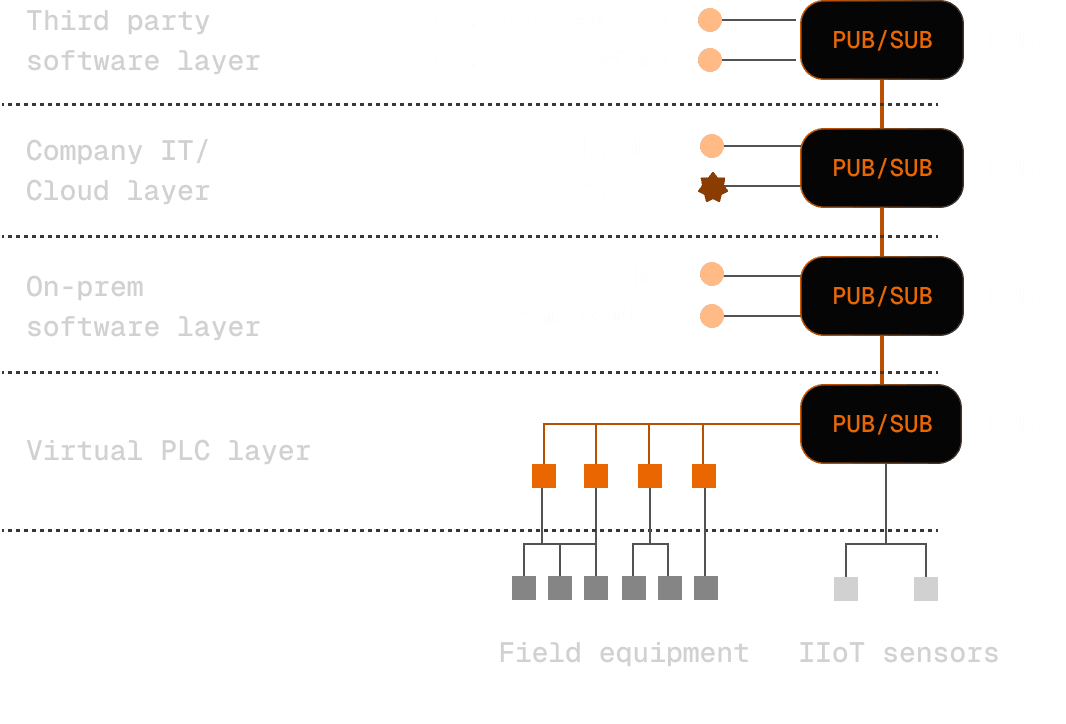
AFTER OTEE
Choose how OTee fits your infrastructure, from individual components to a fully managed platform.
01
OTee Components
Integrate individual OTee components into your own architecture.
02
Self-hosted Platform
Run the complete OTee platform within your own infrastructure, with options for isolated environments.
03
Hosted by OTee
Let OTee host and manage the complete platform for you.
_ DEPLOYMENT ARCHITECTURE


Explore what’s possible with OTee.
Whether you’re building something new or evolving an existing system, discover how OTee can support your control architecture.
_platform
Why OTee is Built for Industrial Control at Scale
OTee replaces the fragmented stack of proprietary controllers, separate OT services, and manual deployment tools with a scalable, software-defined control layer built on Virtual PLC technology. Engineer control logic in a browser-based environment, deploy on open hardware, and manage them centrally across sites.
Hardware independence
Run OTee's Virtual PLC on standard x86 and ARM Linux hardware instead of being tied to proprietary PLC CPUs.
Open integration architecture
With built-in Pub-Sub data framework and standard interfaces like OPC UA, MQTT, and REST, OTee makes control data accessible across systems and easier to integrate safely with modern software and AI.
Security built into the platform
Zero-Trust architecture, end-to-end encryption, RBAC, and auto-certificates help reduce security overhead and support enterprise OT requirements.
Centralized engineering & management of vPLC fleets
Monitor versions, deployments, and rollout status across sites from one place, and push updates or roll back when needed.
_customer cases
Energy Infrastructure
Oil & Gas:
Subsea Control
In offshore operations, control system limitations can lead to major operational and cost consequences. This use case shows how OTee helps modernize water injection control to mitigate cavitation, optimize injection performance, and extend equipment lifespan.
Utilities & Critical Infrastructure
Water/Wastewater:
Distributed Pump Stations
Water utilities depend on reliable control across widely distributed sites. This use case shows how OTee helps utilities modernize pump station operations with remote and centralized management, better data continuity, and lower lifecycle costs.
Industrial Manufacturing
Discrete Manufacturing:
Multi-Plant Control Standardization
Large-scale discrete manufacturing depends on consistent control across plants, lines, and hardware environments. This use case shows how OTee helps standardize automation, simplify lifecycle management, and roll out changes centrally and at scale.